| LINKS | CONTACTS |
|
Four Shared Core Democratic Values
|
|
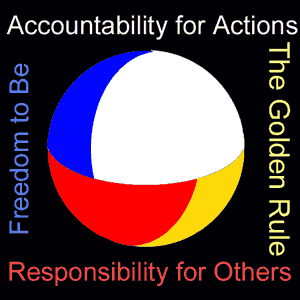
There are no unique and perfect set of core values, but this choice of four is a good place to start. They were selected by listing over a hundred key social issues confronting this country, removing those issues of a purely moral or temporal nature, and then reducing the remainder to a few key ideas. These four shared values are easy to recall; powerful individually and insightful when combined. They are:
A libertarian might be unhappy with a "responsibility for others"- conservatives might claim a"freedom to be" goes too far, and a liberal might insist a "responsibility for others" does not go far enough to protect us from ourselves. Which means these four core democratic values are just about right. The Shared Democratic values logo (above) tries to capture all four doctrines in a single icon. You can click on any Core Value to discover more about its meaning, and each description illuminates potential solutions to many current challenges facing our democracy. Clicking on the center sphere returns you to this page. Shared Democratic Core Values apply to both individuals and to organizations - no government can operate by a different set of rules than those lived by its citizens every day.
|
|
Core Values are Not Moral Judgments Moral, ethical and behavioral
rules are confusing similar- but that confusion can lead to bad
decision and a dysfunctional democracy. The differences matter.
Only in extremely rare circumstances
should moral decisions become the rule of law. |
Strength is a Result of Tension. All successful democratic systems are built on clear rules which at time are contradictory. Our constitutional federation is held together by three, often opposed branches of government- yet that tension forces everyone to sharpen their arguments and avoid responsibility for poor decisions. Dictatorships avoid disagreements by killing the dissenters- democracies welcome tension as a way to adapt their country to changing times. Without giving up its core value system. Your freedom to travel ends at my property line. But, if you see me trying to murder another person in my front yard, your responsibility to others trumps my property rights, and you can rush in to help. My right to hold political or religious beliefs, no matter how distasteful and contrary to your own sense of morality, are mine and mine alone. I can publish those ideas, debate them in public, and raise my children in my image. But, if actions based on those beliefs cause damage to others, then I must take responsibility for rectifying that damage. If they cause my children to do damage to others, then others can step into the parental role to avoid further damage. Only in this way only may balance be achieved.
|
golden rule - responsibility for others - freedom to be - accountability for actions - four core values - links - contact
Copyright
Sharing
Democracy - - www.sharingdemocracy.org